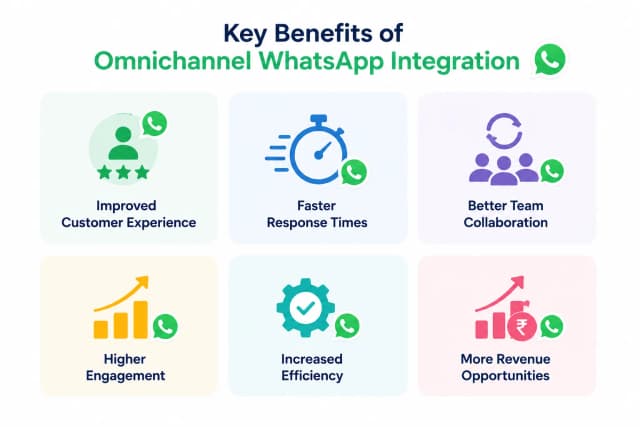
Customers today don't think in channels. They switch from WhatsApp to Instagram to email to a phone call without a second thought — and they expect your team to keep up. When they can't, the experience is frustrating: repeating the same information every time they contact you, waiting for different teams to coordinate, and getting inconsistent answers depending on who they reach.
Omnichannel customer service solves this by connecting every channel into a single, unified system. This guide explains what it is, why it matters in 2026, and how to build it.
What Is Omnichannel Customer Service?
Omnichannel customer service is an approach to customer support and engagement where all communication channels — WhatsApp, Instagram, email, voice, live chat, and others — are connected in a single platform, sharing:
- Customer profiles — one record per customer, regardless of which channel they use
- Conversation history — every interaction visible to every agent, on every channel
- Automation rules — workflows that trigger across channels based on customer behaviour
- Analytics — unified reporting showing performance across all channels
The word "omni" means "all" — and the defining characteristic is that data flows freely between channels so the customer experience is seamless, no matter how many channels are involved.
Multichannel vs. Omnichannel: The Critical Difference
These terms are often confused, but they describe fundamentally different approaches:
| Aspect | Multichannel | Omnichannel |
|---|---|---|
| Channel presence | Multiple channels | Multiple channels |
| Data sharing | Siloed — each channel manages its own data | Unified — all channels share a single customer record |
| Conversation continuity | Restarted on each channel | Continuous — agent sees full history across channels |
| Automation | Channel-by-channel | Cross-channel workflows |
| Customer experience | Inconsistent | Consistent |
Example: A customer messages you on WhatsApp about a delayed order, then follows up by email.
- Multichannel: The email agent has no idea about the WhatsApp conversation. The customer has to explain everything again.
- Omnichannel: The email agent sees the full WhatsApp conversation history and the order context. They can resolve immediately without asking the customer to repeat themselves.
Why Omnichannel Matters More in 2026
Five trends are making omnichannel customer service a competitive necessity rather than a nice-to-have:
1. Customer channel preferences are fragmented
Different customer segments prefer different channels. Gen Z uses Instagram DMs. Millennials prefer WhatsApp. Older demographics prefer email and phone. If you're not present and unified across channels, you're invisible to part of your market.
2. WhatsApp has become a primary business channel
WhatsApp Business API has crossed 200 million monthly active business users globally. In many markets (India, Brazil, Southeast Asia, MENA), WhatsApp is the default customer communication channel — more important than email for real-time service.
3. AI makes omnichannel practical at any team size
Previously, true omnichannel required a large support team to staff every channel around the clock. AI agents can now handle routine queries across all channels simultaneously — making 24/7 omnichannel support viable for businesses of any size.
4. Customers expect continuity
Research consistently shows that one of the top customer service frustrations is having to repeat information when switching channels or speaking to a different agent. Omnichannel eliminates this — any agent can see the full history and continue the conversation.
5. Unified analytics reveal the full customer journey
Without omnichannel integration, you can't see which channels drive revenue, where customers get stuck, or how cross-channel journeys perform. Omnichannel data is the foundation of customer journey optimization.
The Business Impact of Omnichannel Customer Service
Organizations that implement omnichannel customer service report:
- 89% higher customer retention compared to non-omnichannel companies (Aberdeen Group)
- 30–35% improvement in first-contact resolution when agents have cross-channel history
- 40% reduction in average handling time (no need to ask customers to repeat information)
- 25–30% improvement in customer satisfaction scores (CSAT/NPS)
- 20–25% increase in customer lifetime value for omnichannel customers vs. single-channel
The ROI case is clear: customers who receive a consistent, connected experience buy more and stay longer.
The Five Channels That Matter Most
Not all channels deliver equal value. For most businesses in 2026, prioritize:
1. WhatsApp Business API
- Why: 2+ billion users globally, 98% open rates, preferred for conversational commerce in many markets
- Best for: Real-time support, transactional messages, appointment booking, order updates, lead nurturing
- AI compatibility: Excellent — AI chatbots handle WhatsApp conversations naturally
2. Instagram Direct
- Why: Critical for brands with a social media presence; customers increasingly expect support via DM
- Best for: Discovery queries, influencer-driven leads, visual product support, brand community
- AI compatibility: Strong — AI handles common queries; human agents handle relationship-sensitive DMs
3. Email
- Why: Formal communication, detailed documentation, transactional receipts
- Best for: Order confirmations, billing inquiries, formal complaints, detailed instructions
- AI compatibility: Good — AI drafts responses for human approval or handles routine automated emails
4. Voice (Phone/AI Calling)
- Why: Still preferred for urgent, complex, or high-stakes queries; highest emotional bandwidth
- Best for: Complex support, sales escalations, high-value customer relationships
- AI compatibility: Excellent for routine calls; human agents required for complex and emotional calls
5. Live Chat (Website)
- Why: Captures high-intent website visitors at the moment of purchase consideration
- Best for: Pre-purchase questions, product comparisons, trial sign-up support
- AI compatibility: Strong — AI handles FAQs; human agents close deals
How to Build an Omnichannel Customer Service Strategy
Step 1: Map Your Customer Journey Across Channels
Before connecting channels, understand how your customers actually use them:
- Where do most support requests originate? (WhatsApp, Instagram, email?)
- Which channel do customers switch to when they don't get a response?
- What are the most common queries on each channel?
- Which channels are associated with the highest CSAT? The lowest?
This mapping reveals where to prioritize and where the biggest pain points are.
Step 2: Choose Your Platform
Look for an omnichannel platform that provides:
- Native integration with WhatsApp Business API, Instagram Direct, email, and voice
- Unified inbox — all conversations in one view for all agents
- Shared customer profiles — single record per customer across channels
- Cross-channel automation — workflows that trigger and act across channels
- AI agent capability — handles routine queries on all channels
- CRM integration — syncs customer data to your existing CRM
Step 3: Connect Channels and Configure Your Inbox
Once the platform is selected:
- Connect WhatsApp Business API (requires Meta verification)
- Connect Instagram business account
- Configure email inbox
- Set up voice integration if applicable
- Configure team routing — which agents/teams handle which channels
- Set SLA targets per channel (e.g., WhatsApp: respond within 5 minutes; email: within 4 hours)
Step 4: Deploy AI for Routine Queries
Train your AI agent on:
- Product and service documentation
- Your FAQ content
- Common support scripts
- Pricing and policy information
Configure the AI to handle routine queries autonomously on all channels and escalate to human agents when confidence is low or the customer requests a human.
Step 5: Build Cross-Channel Automation Workflows
Examples of powerful cross-channel automations:
- Lead capture → WhatsApp follow-up: When a web form is submitted, send an immediate WhatsApp message with next steps
- Order placed → WhatsApp shipping update: Trigger WhatsApp notifications at each shipping milestone
- No response on WhatsApp → Email follow-up: If a customer doesn't reply to a WhatsApp message in 24 hours, send an email
- Support ticket closed → CSAT survey: After resolution, automatically send a satisfaction survey on the customer's preferred channel
Step 6: Measure and Optimize
Track these metrics across all channels:
| Metric | What It Tells You |
|---|---|
| First Response Time (FRT) | How quickly you respond on each channel |
| First Contact Resolution (FCR) | Queries resolved without follow-up |
| CSAT by channel | Customer satisfaction per channel |
| AI resolution rate | % of queries resolved by AI vs. human |
| Channel switching rate | How often customers move between channels |
| Revenue attribution by channel | Which channels drive actual sales |
Common Omnichannel Mistakes to Avoid
❌ Adding channels without connecting them Launching on Instagram while keeping it separate from your WhatsApp inbox makes things worse. Only add channels when they're connected to your unified platform.
❌ Treating all channels identically WhatsApp conversations are casual and fast. Email is more formal. Instagram DMs are brief. Adapt your tone and response speed expectations to each channel's norms.
❌ Deploying AI without proper training Poorly trained AI gives wrong answers, damaging trust across all channels simultaneously. Train on real support data before deployment and monitor accuracy continuously.
❌ Ignoring channel preferences Don't force customers onto your preferred channel. If a customer always contacts you on WhatsApp, don't route them to email for follow-up. Honor their channel preference in your automation logic.
❌ Measuring channels in isolation If you only measure WhatsApp performance and email performance separately, you'll miss the fact that customers who use both channels have higher LTV — and you won't understand the cross-channel journey that drives that value.
Omnichannel Customer Service With Duochat
Duochat's omnichannel communication platform provides:
- Unified inbox for WhatsApp, Instagram, email, and voice
- AI agent that handles routine queries on all channels simultaneously
- Cross-channel automation — build workflows that span channels in a no-code builder
- Shared customer profiles — 360° view across all touchpoints
- CRM integration with HubSpot, Salesforce, and Zoho
- Omnichannel analytics — performance and revenue attribution across all channels
Most businesses are live with a unified omnichannel inbox within one business day.
Summary
Omnichannel customer service connects all your customer communication channels — WhatsApp, Instagram, email, voice — into a single platform with shared customer data, conversation history, and automation. The result: customers get consistent, connected experiences regardless of how they contact you, and your team resolves issues faster because they always have full context.
In 2026, omnichannel is increasingly a baseline expectation, not a differentiator. The businesses winning on customer experience are the ones who've unified their channels, deployed AI for routine queries, and built cross-channel automation workflows that make every customer interaction feel seamless.
Next steps: Explore Duochat's omnichannel platform or learn about WhatsApp omnichannel integration.